Showing posts with label clemmons nc property management. Show all posts

Thursday, November 5, 2026

Winston Salem Market Update - 11-5-26


winston salem real estate

What do the numbers really say about Winston Salem single family homes right now? 🧐

If you’re thinking about buying, selling, or investing in Winston Salem, these are the facts on what’s out there:

  • Homes here are listed around $319,000, so buyers and sellers can see exactly where the middle of the market sits. 💸

  • 801 homes are on the market, which means plenty of choice for anyone searching. 🔍

  • These homes have been listed about 57 days, giving buyers and sellers a sense of how long most options are waiting before someone makes a move. ⏳

Knowing these details helps both sellers aiming for the top price and buyers looking for a fair deal.

Which factor matters most to you when looking at Winston Salem homes, price, number of choices, or timing?

Let us know how we can help!

We believe every family should feel confident when buying and selling their Winston Salem and Lake Norman Area Home.

#RealEstate #winstonsalemrealestate #propertrymanagement #clemmonsrealestate #lakenormanrealestate,

Tuesday, October 14, 2025

Winston Salem | Idea for Getting Your Home Sold

 Your Winston Salem Realtor For Life!


Remember, meeting and asking questions never costs you anything.   Let me help with you with one of your most important decisions.

Tuesday, July 22, 2025

What Do Property Management Companies Charge around Winston Salem?

Roby Robertson Owner Carolina Living Real Estate

Property managers typically charge a fee for handling the day-to-day operations of managing a rental property. The fees can vary depending on the services they provide, the location of the property, and the type of property being managed. Here's a breakdown of what you can expect:

1. Management Fee (Monthly):

  • Typical Range: 8% to 12% of the monthly rent.   Carolina Living has an 8% starting rate!

  • This is the fee the property manager charges for handling the day-to-day tasks like finding tenants, screening applicants, collecting rent, coordinating maintenance, and managing the property's financials.

Example: If the property rents for $2,000 per month, the management fee would be between $160 and $240.  

2. Leasing or Placement Fee:

  • Typical Range: 50% to 100% of one month's rent.  Carolina Living does NOT charge for this.

  • This fee is charged when the property manager finds a new tenant. It often includes marketing the property, showing it to prospective tenants, and handling the lease signing.

Example: If the property rents for $2,000 per month, the leasing fee might be anywhere from $1,000 to $2,000.

3. Maintenance Fees:

  • Property managers often coordinate maintenance and repairs, but they may charge an additional fee for managing these tasks. This fee could be a flat rate or a percentage of the repair costs (typically around 10%).   Carolina Living Does NOT charge to dispatch maintenance vendors.

Example: If a repair costs $500, the manager might charge $50 for coordinating the job.

4. Renewal Fees:

  • Typical Range: $100 to $300.  Carolina Living does NOT charge for this.

  • When a current tenant renews their lease, the property manager may charge a renewal fee. This is often lower than the leasing fee, as less work is involved in renewing an existing tenant.

5. Eviction Fees:

  • Typical Range: $300 to $500 (or higher).  Carolina Living Pays for this out of Tenant Security Deposit.

  • If the property manager has to initiate an eviction process, they may charge an additional fee for handling the legal steps, paperwork, and court appearances.

6. Other Miscellaneous Fees: Carolina Living does NOT charge for this.

  • Advertising Fees: If the property manager uses a paid service to advertise your property, they may charge you for those costs.

  • Inspection Fees: Some managers charge for periodic property inspections (e.g., for move-in, move-out, or regular property checks).

Overall Costs:

For a typical single-family rental, property management fees often fall between 10% to 15% of the monthly rent, considering the combined leasing and management services. For multi-unit properties or commercial real estate, the fees can sometimes be lower (around 5% to 8%) since the work involved might be less per unit.

Things to Keep in Mind:

  • Negotiability: Many fees are negotiable, especially if you have multiple properties or are willing to sign a long-term contract.

  • Services Included: Always clarify what services are covered under the management fee. For example, some property managers may include maintenance coordination, tenant screening, and rent collection in their base fee, while others may charge extra for these services.

  • Hidden Costs: Be cautious about "hidden fees" that might be tacked on for things like handling late rent payments or preparing detailed financial reports.

Are you thinking about hiring a property manager, or just curious about the costs involved? If you’re managing rental properties yourself or want to find ways to negotiate a better deal, I can offer more tips too!

Tuesday, February 11, 2025

Winston Salem | What Is The Eviction Process

This is a video we made a few years ago but many of the processes still exist today. A couple of pieces of information that have changed since the move to Winston Salem! Phone - 704 451 7051 email - carolinalivingrealestate@yahoo.com Years in business of property management - 20

Tuesday, February 8, 2022

Winston Salem - The Top Indicator if You Want To Know Where Mortgage Rates Are Heading


The Top Indicator if You Want To Know Where Mortgage Rates Are Heading | MyKCM

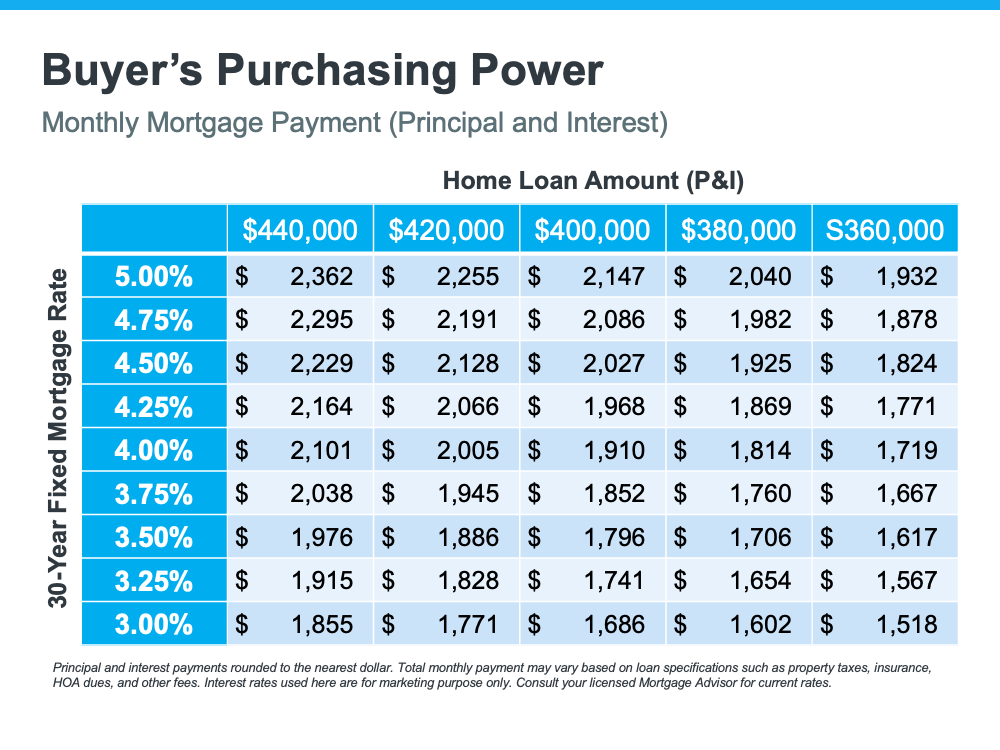
Mortgage rates have increased significantly since the beginning of the year. Each Thursday, Freddie Mac releases its Primary Mortgage Market Survey. According to the latest survey, the average 30-year fixed-rate mortgage has risen from 3.22% at the start of the year to 3.55% as of last week. This is important to note because any increase in mortgage rates changes what a purchaser can afford. To give you an idea of how rising mortgage rates impact your purchasing power, see the table below:

The Top Indicator if You Want To Know Where Mortgage Rates Are Heading | MyKCM

How Can You Know Where Mortgage Rates Are Headed?

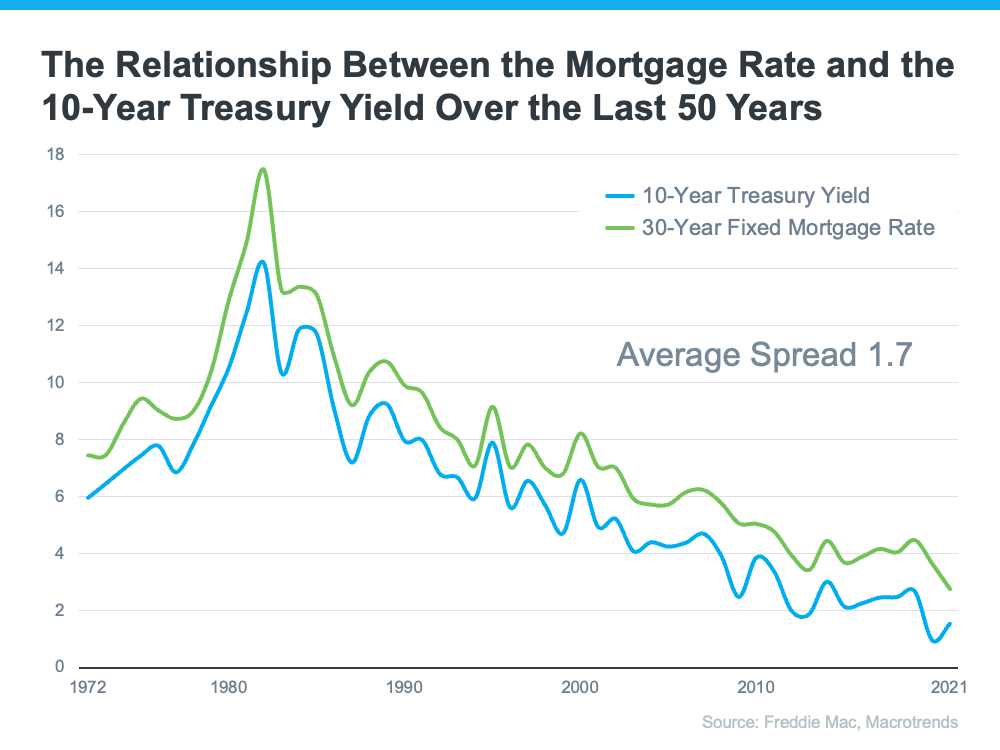
While it’s always difficult to know exactly where mortgage rates will go, a great indicator of where they may head is by looking at the 50-year history of the 10-year treasury yield, and then following its path. Understanding the mechanics of the treasury yield isn’t as important as knowing that there’s a correlation between how it moves and how mortgage rates follow. Here’s a graph showing that relationship over the last 50 years:

The Top Indicator if You Want To Know Where Mortgage Rates Are Heading | MyKCM

This correlation has continued into the new year. The treasury yield has started to climb, and that’s driven rates up. As of last Thursday, the treasury yield was 1.81%. That’s 1.74% below the mortgage rate reported the same day (3.55%) and is very close to the average spread we see between the two numbers (average spread is 1.7).

Where Will the Treasury Yield Head in the Future?

With this information in mind, a 10-year treasury-yield forecast would be a good indicator of where mortgage rates may be headed. The Wall Street Journal just surveyed a panel of over 75 academic, business, and financial economists asking them to forecast the treasury yield over the next few years. The consensus was that experts project the treasury yield will climb to 2.84% by the end of 2024. Based on the 50-year history of following this yield, that would likely put mortgage rates at about 4.5% in three years.

While the correlation between the 30-year fixed mortgage rate and the 10-year treasury yield is clear in the data shown above for the past 50 years, it shouldn’t be used as an exact indicator. They’re both hard to forecast, especially in this unprecedented economic time driven by a global pandemic. Yet understanding the relationship can help you get an idea of where rates may be going. It appears, based on the information we have now, that mortgage rates will continue to rise over the next few years. If that’s the case, your best bet may be to purchase a home sooner rather than later, if you’re able.

Bottom Line

Forecasting mortgage rates is very difficult. As Mark Fleming, Chief Economist at First American, once said:

“You know, the fallacy of economic forecasting is don’t ever try and forecast interest rates and or, more specifically, if you’re a real estate economist mortgage rates, because you will always invariably be wrong.”

However, if you’re either a first-time homebuyer or a current homeowner thinking of moving into a home that better fits your changing needs, understanding what’s happening with the 10-year treasury yield and mortgage rates can help you make an informed decision on the timing of your purchase.

Monday, September 20, 2021

Winston Salem | The Truth About Today’s Buyer Demand


Let Carolina Living Real Estate Guide You Through This Market

The Truth About Today’s Buyer Demand | MyKCM

When it comes to the latest news in real estate, there are a lot of sensational headlines in the media. In times like this, when it can be hard to know what to believe, put your trust in the experts. Those of us in the housing market respect that buying or selling a home is a major life decision, and we offer advice based on what the data shows.

Despite what you may have read, the housing market is still undeniably strong. Here’s a look at what leading experts have to say about buyer demand today and how it continues to shape the industry:

Michael Lane, President at ShowingTime:

“In general, there are definite signs of cooling demand. However, buyer traffic is still at historically high levels compared to pre-pandemic showings.”

Odeta Kushi, Deputy Chief Economist at First American:

“Seasonally adjusted purchase applications tick up slightly to the highest level since July. Demand for homes remains strong and steady. Excluding 2020 (not a good benchmark) purchase applications are the strongest in a decade.” 

Selma Hepp, Deputy Chief Economist at CoreLogic:

“Home buyer demand pushed price growth to a new record high in June, with S&P CoreLogic national Case-Shiller Index clocking in an 18.6% year-over-year growth rate. The month-to-month index jumped 2.18%, making it another strong monthly growth, and the fastest May-to-June increase since the data series began.”

What It Means for You

As a seller, buyer demand is an important factor that helps influence how fast your house will sell and how many buyers may be competing for it. When buyers have to compete against each other for a limited supply of available homes, bidding wars can drive prices up. While things have cooled slightly since the peak of the pandemic housing rush, buyer demand is still far surpassing historical norms. That’s why we’re still in a sellers’ market.

Bottom Line

If you’re torn on whether or not you want to sell your home this year, rest assured it’s still a great time to make a move. Let’s connect to discuss how you can sell now and do it on your best terms thanks to today’s buyer demand.

Tuesday, July 27, 2021

Winston Salem | A Look at Housing Supply and What It Means for Sellers


Carolina Living Real Estate and Property Management Can Guide You Through This Market!

A Look at Housing Supply and What It Means for Sellers | MyKCM

One of the hottest topics of conversation in today’s real estate market is the shortage of available homes. Simply put, there are many more potential buyers than there are homes for sale. As a seller, you’ve likely heard that low supply is good news for you. It means your house will get more attention, and likely, more offers. But as life begins to return to normal, you may be wondering if that’s something that will change.

While it may be tempting to blame the pandemic for the current inventory shortage, the pandemic can’t take all the credit. While it did make some sellers hold off on listing their houses over the past year, the truth is the low supply of homes was years in the making. Let’s take a look at the root cause and what the future holds to uncover why now is still a great time to sell.

Where Did the Shortage Come From?

It’s not just today’s high buyer demand. Our low supply goes hand-in-hand with the number of new homes built over the past decades. According to Sam Khater, VP and Chief Economist at Freddie Mac:

“The main driver of the housing shortfall has been the long-term decline in the construction of single-family homes.”

Data in a recent report from the National Association of Realtors (NAR) tells the same story. New home construction has been lagging behind the norm for quite some time. Historically, builders completed an average of 1.5 million new housing units per year. However, since the housing bubble in 2008, the level of new home construction has fallen off (see graph below):A Look at Housing Supply and What It Means for Sellers | MyKCMThe same NAR report elaborates on the impact of this below-average pace of construction:
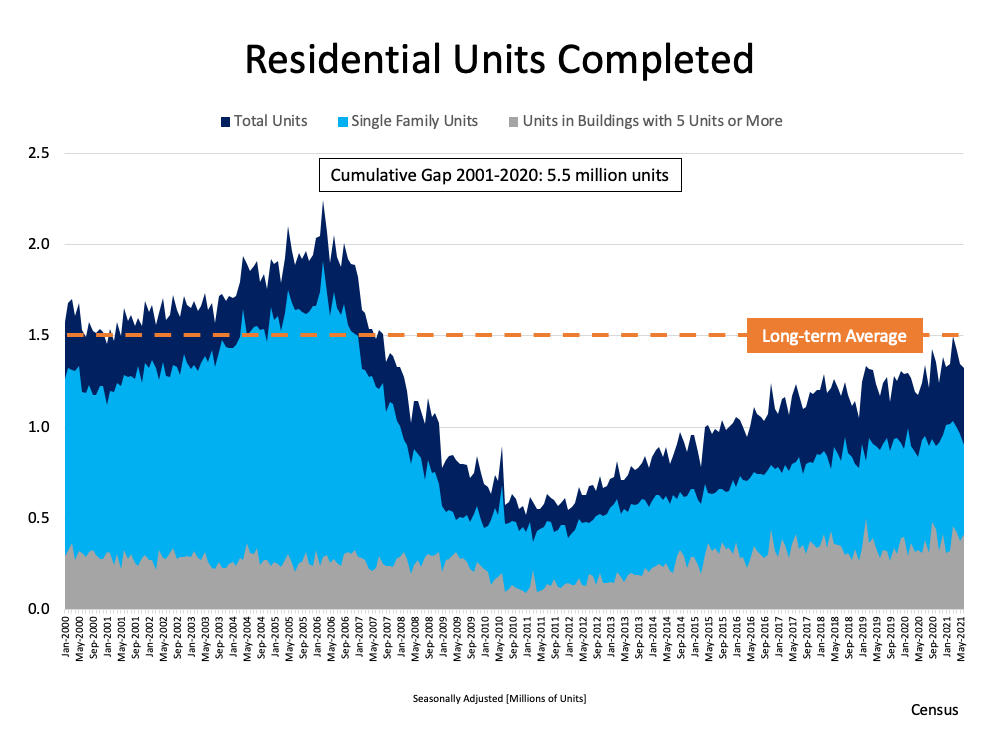
“. . . the underbuilding gap in the U.S. totaled more than 5.5 million housing units in the last 20 years.” 

“Looking ahead, in order to fill an underbuilding gap of approximately 5.5 million housing units during the next 10 years, while accounting for historical growth, new construction would need to accelerate to a pace that is well above the current trend, to more than 2 million housing units per year. . . .”

That means if we build even more new houses than the norm every year, it’ll still take a decade to close the underbuilding gap contributing to today’s supply-and-demand mix. Does that mean today’s ultimate sellers’ market is here to stay?

We’re already starting to see an increase in new home construction, which is great news. But newly built homes can’t bridge the supply gap we’re facing right now on their own. In the State of the Nation’s Housing 2021 Report, the Joint Center for Housing Studies of Harvard University (JCHS) says:

“…Although part of the answer to the nation’s housing shortage, new construction can only do so much to ease short-term supply constraints. To meet today’s strong demand, more existing single-family homes must come on the market.”

Early Indicators Show More Existing-Home Inventory Is on Its Way

When we look at existing homes, the latest reports signal that housing supply is growing gradually month-over-month. This uptick in existing homes for sale shows things are beginning to shift. Based on recent data, Odeta Kushi, Deputy Chief Economist at First American, has this to say:

“It looks like existing inventory is starting to inch up, which is good news for a housing market parched for more supply.”

Lawrence Yun, Chief Economist at NAR, echoes that sentiment:

“As the inventory is beginning to pick up ever so modestly, we are still facing a housing shortage, but we may have turned a corner.”

So, what does all of this mean for you? Just because life is starting to return to normal, it doesn’t mean you missed out on the best time to sell. It’s not too late to take advantage of today’s sellers’ market and use rising equity and low interest rates to make your next move.

Bottom Line

It’s still a great time to sell. Even though housing supply is starting to trend up, it’s still hovering near historic lows. Let’s connect to discuss how you can list your house now and use the inventory shortage to get the best possible terms for you.

Wednesday, July 14, 2021

Winston Salem | Why This Isn’t Your Typical Summer Housing Market


Carolina Living Real Estate and Roby Robertson Will Help Throughout Your Real Estate Process

Why This Isn’t Your Typical Summer Housing Market | MyKCM

In real estate, it’s normal to see ebbs and flows in the market. Typically, the summer months are slower-paced than the traditionally busy spring. But this isn’t a typical summer. As the economy rebounds and life is returning to normal, the real estate market is expected to have an unusually strong summer season.

Here’s how this summer is stacking up against the norm and what it means for you.Why This Isn’t Your Typical Summer Housing Market | MyKCM

Inventory is increasing.

According to the latest Existing Home Sales Report from the National Association of Realtors (NAR), inventory levels have been rising since February of this year. Looking at the graph below, there’s a clear upward trend, as shown in the green bars. Currently, there’s roughly a 2.5 months’ supply of homes for sale. And while inventory is trending up as more houses are coming to the market, it’s still much lower than several of the previous summers, as the orange bars indicate.Why This Isn’t Your Typical Summer Housing Market | MyKCMIf you’re looking to buy, some relief is on the way in the form of more homes coming to the market. Just remember, we still have less inventory than the norm, so be patient in your search.

If you’re thinking of selling, now is the time. Work with your agent to list your house before it has more competition on the market.

Time on the market is still shorter than normal.

Unlike the typical summer trend, time on the market is moving at the fastest speed we’ve seen since NAR started collecting this survey-based information in 2011. The most recent Realtors Confidence Index shows that the average home is on the market for just 17 days, as shown in green in the graph below. This means houses are selling at a much faster pace than a typical summer, which the orange bars represent.Why This Isn’t Your Typical Summer Housing Market | MyKCMIf you’re looking to buy, this means you need to be prepared to move fast. Brace for a quick pace and rely on your agent to stay in the know on the available homes in your area.

If you’re thinking of selling, data shows your house will likely sell quickly. If you’re worried about where you’ll go once your house sells, consider a newly built home as a good way to move up.

Price appreciation is still rising.

The last big factor making this an unusually strong market this summer is home price appreciation. According to the State House Price Index from the Federal Housing Finance Agency (FHFA), we’re currently experiencing double-digit house price appreciation and have an average of 12.6% appreciation across the country. The graph below uses data from NAR to show a more granular view of how prices have changed month-to-month over the past few years. The green bars show the current price appreciation we’re experiencing today. Our current levels are well above what we’ve seen in recent summers, shown by the orange bars.Why This Isn’t Your Typical Summer Housing Market | MyKCMIf you’re looking to buy, competition and bidding wars are driving prices up. Getting pre-approved can show the seller you’re serious and help you know what you can afford. Once you do, work with your agent to make a strong offer that stands out.

If you’re thinking of selling, seize this opportunity to use your additional equity from this price appreciation to power your next move.

Bottom Line

This isn’t a typical summer. Whether you’re buying or selling, let’s connect to talk about how you can capitalize on today’s market conditions to sell your house or find your dream home.

Monday, May 3, 2021

Winston Salem - Is Home Price Appreciation Accelerating Again?


Let Carolina Living Real Estate Guide You Through These Chaotic times.

Is Home Price Appreciation Accelerating Again? | MyKCM

At the beginning of the year, industry forecasts called for home price appreciation to slow to about half of the double-digit increase we saw last year. The thinking was that inventory would increase from record-low levels and put an end to the bidding wars that have driven home prices up over the past twelve months. However, that increase in inventory has yet to materialize. The National Association of Realtors (NAR) reports that there are currently 410,000 fewer single-family homes available for sale than there were at this time last year.

This has forced those who made appreciation forecasts this past January to amend those projections. The Mortgage Bankers Association, Fannie Mae, Freddie Mac, the National Association of Realtors, and Zelman & Associates have all adjusted their numbers upward after reviewing first quarter housing data. Here are their original forecasts and their newly updated projections:Is Home Price Appreciation Accelerating Again? | MyKCMEven with the increases, the updated projections still don’t reach the above 10% appreciation levels of 2020. However, a jump in the average projection from 5.3% to 7.7% after just one quarter is substantial. Demand will remain strong, so future appreciation will be determined by how quickly listing inventory makes its way to the market.

Bottom Line

Entering 2021, there was some speculation that we might see price appreciation slow dramatically this year. Today, experts believe that won’t be the case. Home values will remain strong throughout the year.

Thursday, January 28, 2021

Winston Salem - What Record-Low Housing Inventory Means for You

 We believe every family should feel confident when buying and selling a home.


What Record-Low Housing Inventory Means for You | MyKCM

The real estate market is expected to do very well in 2021, with mortgage rates that are hovering at historic lows and forecasted by experts to remain favorable throughout the year. One challenge to the housing industry, however, is the lack of homes available for sale today. Last week, the National Association of Realtors (NAR) released their Existing Home Sales Report, which shows that the inventory of homes for sale is currently at an all-time low. The report explains:

“Total housing inventory at the end of December totaled 1.07 million units, down 16.4% from November and down 23% from one year ago (1.39 million). Unsold inventory sits at an all-time low 1.9-month supply at the current sales pace, down from 2.3 months in November and down from the 3.0-month figure recorded in December 2019. NAR first began tracking the single-family home supply in 1982.”
(See graph below):

What Record-Low Housing Inventory Means for You | MyKCM

What Does This Mean for You?

If You’re a Buyer:

Be patient during your home search. It may take time to find a home you love. Once you do, however, be ready to move forward quickly. Get pre-approved for a mortgage, be prepared to make a competitive offer from the start, and know that a shortage in inventory could mean you’ll enter a bidding war. Calculate just how far you’re willing to go to secure a home and lean on your real estate professional as an expert guide along the way. The good news is, more inventory is likely headed to the market soon, Lawrence Yun, Chief Economist at NAR, notes:

"To their credit, homebuilders and construction companies have increased efforts to build, with housing starts hitting an annual rate of near 1.7 million in December, with more focus on single-family homes…However, it will take vigorous new home construction in 2021 and in 2022 to adequately furnish the market to properly meet the demand."

If You’re a Seller:

Realize that, in some ways, you’re in the driver’s seat. When there’s a shortage of an item at the same time there’s a strong demand for it, the seller is in a good position to negotiate the best possible terms. Whether it’s the price, moving date, possible repairs, or anything else, you’ll be able to request more from a potential purchaser at a time like this – especially if you have multiple interested buyers. Don’t be unreasonable, but understand you probably have the upper hand.

Bottom Line

The housing market will remain strong throughout 2021. Know what that means for you, whether you’re buying, selling, or doing both.

Saturday, January 23, 2021


According to experts, now is the time to put the pedal to the metal if you’re planning to buy a home. Easing onto the track could set you up to hit heavier buyer traffic down the road or miss out on today’s record-low interest rates. Contact Roby Robertson if you’re ready to cross finish line and find your dream home.


Friday, January 22, 2021

Financial Fundamentals for Homebuyers


Contact Carolina Living Real Estate to Help you get started.

Financial Fundamentals for Homebuyers [INFOGRAPHIC] | MyKCM

Some Highlights

  • When you’re thinking about buying a home, there are a few key steps to take before you even start to look at houses.
  • From saving for your down payment to getting pre-approved for a mortgage, you’ll want to make sure you keep your financial plan on track from the beginning.
  • Let’s connect today to make sure you have an introduction to a trusted lender and the best possible real estate guidance as you begin your homebuying process.

Wednesday, January 20, 2021

Owning a Home Is Still More Affordable Than Renting One

 Roby Robertson and Carolina Living Real Estate believes every family should feel confident when buying and selling a home

Owning a Home Is Still More Affordable Than Renting One | MyKCM

If spending more time at home over the past year is making you really think hard about buying a home instead of renting one, you’re not alone. You may be wondering, however, if the dollars and cents add up in your favor as home prices continue to rise. According to the experts, in many cases, it’s still more affordable to buy a home than rent one. Here’s why.

ATTOM Data Solutions recently released the 2021 Rental Affordability Report, which states:

“Owning a median-priced three-bedroom home is more affordable than renting a three-bedroom property in 572, or 63 percent of the 915 U.S. counties analyzed for the report.

That has happened even though median home prices have increased more than average rents over the past year in 83 percent of those counties and have risen more than wages in almost two-thirds of the nation.”

How is this possible?

The answer: historically low mortgage interest rates. Todd Teta, Chief Product Officer with ATTOM Data Solutions, explains:

“Home-prices are rising faster than rents and wages in a majority of the country. Yet, home ownership is still more affordable, as amazingly low mortgage rates that dropped below 3 percent are helping to keep the cost of rising home prices in check.”

In 2020, mortgage rates reached all-time lows 16 times, and so far, they’re continuing to hover in low territory this year. These low rates are a big factor in driving affordability. Teta also notes:

“It’s startling to see that kind of trend. But it shows how both the cost of renting has been relatively high compared to the cost of ownership and how declining interest rates are having a notable impact on the housing market and home ownership. The coming year is totally uncertain, amid so many questions connected to the Coronavirus pandemic and the broader economy. But right now, owning a home still appears to be a financially-sound choice for those who can afford it.”

Bottom Line

If you’re considering buying a home this year, let’s connect today to discuss the options that match your budget while affordability is in your favor.

Monday, January 11, 2021

Winston Salem: What Does 2021 Have in Store for Home Values?

Carolina Living Real Estate and Roby Robertson believes every family should feel confident when buying and selling a home.

What Does 2021 Have in Store for Home Values? | MyKCM

According to the latest CoreLogic Home Price Insights Report, nationwide home values increased by 8.2% over the last twelve months. The dramatic rise was brought about as the inventory of homes for sale reached historic lows at the same time buyer demand was buoyed by record-low mortgage rates. As CoreLogic explained:

“Home price growth remained consistently elevated throughout 2020. Home sales for the year are expected to register above 2019 levels. Meanwhile, the availability of for-sale homes has dwindled as demand increased and coronavirus (COVID-19) outbreaks continued across the country, which delayed some sellers from putting their homes on the market.

While the pandemic left many in positions of financial insecurity, those who maintained employment and income stability are also incentivized to buy given the record-low mortgage rates available; this is increasing buyer demand while for-sale inventory is in short supply.”

Where will home values go in 2021?

Home price appreciation in 2021 will continue to be determined by this imbalance of supply and demand. If supply remains low and demand is high, prices will continue to increase.

Housing Supply

According to the National Association of Realtors (NAR), the current number of single-family homes for sale is 1,080,000. At the same time last year, that number stood at 1,450,000. We are entering 2021 with approximately 270,000 fewer homes for sale than there were one year ago.

However, there is some speculation that the inventory crush will ease somewhat as we move through the new year for two reasons:

1. As the health crisis eases, more homeowners will be comfortable putting their houses on the market.

2. Some households impacted financially by the pandemic will be forced to sell.

Housing Demand

Low mortgage rates have driven buyer demand over the last twelve months. According to Freddie Mac, rates stood at 3.72% at the beginning of 2020. Today, we’re starting 2021 with rates one full percentage point lower than that. Low rates create a great opportunity for homebuyers, which is one reason why demand is expected to remain high throughout the new year.

Taking into consideration these projections on housing supply and demand, real estate analysts forecast homes will continue to appreciate in 2021, but that appreciation may be at a steadier pace than last year. Here are their forecasts:What Does 2021 Have in Store for Home Values? | MyKCM

Bottom Line

There’s still a very limited number of homes for sale for the great number of purchasers looking to buy them. As a result, the concept of “supply and demand” mandates that home values in the country will continue to appreciate.